
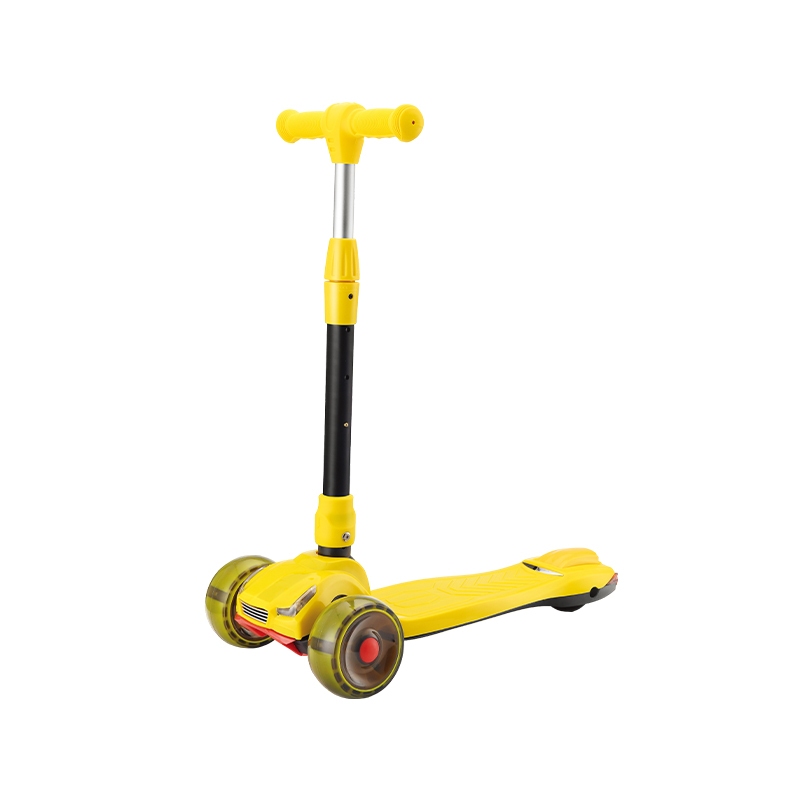
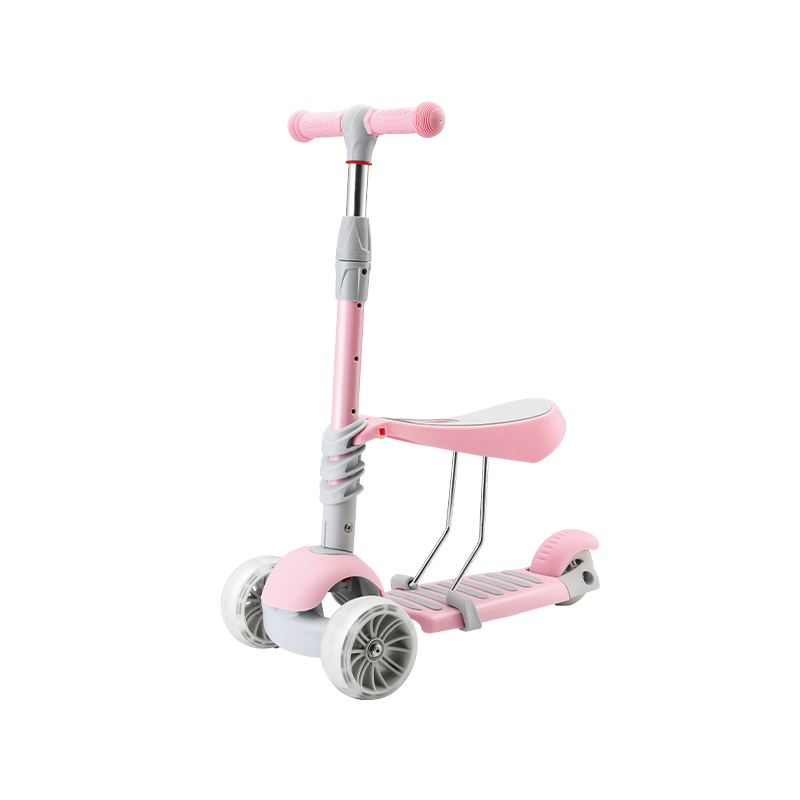

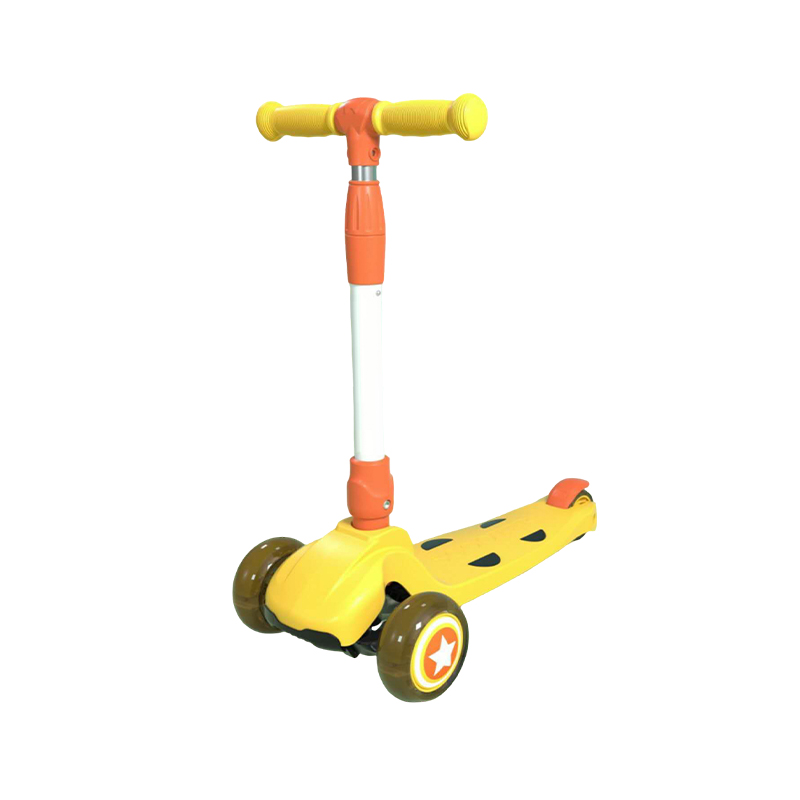


Do the surface texture and chamfered edges of children's scooter pedals balance slip resistance with the risk of scratches from falls?
Release Time : 2025-12-18
In the design of children's scooters, the pedals, seemingly just a platform for children to stand on, actually serve multiple purposes: safety, control, and experience. Especially for children whose motor coordination is developing, even a minor slip or scrape can cause not only physical pain but also undermine their confidence in exploring the world. Therefore, the design of the pedal surface texture and chamfered edges must strike a delicate balance between "slip resistance" and "fall protection"—ensuring a stable foothold while riding, and minimizing the risk of scratches in the event of an accidental fall.
Slip resistance is the primary requirement for pedal functionality. Children have limited foot strength, and shoe soles come in various materials. If the pedals are too slippery during acceleration, turning, or braking, the feet can easily slip, causing a loss of control of the scooter. Therefore, designers typically emboss or spray-paint high-friction textures on the pedal surface, such as fine particles, wavy grooves, or honeycomb bumps. These microstructures effectively engage with the sole, enhancing lateral and longitudinal grip and providing reliable support even on slightly wet surfaces or when riding in sandals. However, if the texture is too sharp, raised too high, or has sharp edges, it can become an "invisible blade" when a child accidentally falls or their hands or knees brush against the pedals, causing scratches or even abrasions.
This leads to the crucial role of edge chamfering design. Chamfering refers to rounding off the cut edges of the pedal's metal or plastic sheeting, eliminating right angles or burrs. High-quality children's scooters feature pedals with large-radius rounded transitions around the edges, eliminating any sharpness whether stepping on from above or touching from the side. This treatment not only improves tactile comfort but also creates a "soft boundary" in the event of a fall—when a child instinctively braces themselves with their hands or slides sideways across the pedal, the rounded edges disperse the impact, preventing concentrated cuts. Some high-end products even wrap the sides of the pedals with flexible TPE rubber for further cushioning, achieving a balance of rigidity and flexibility.
A deeper consideration lies in the synergy between materials and processes. While aluminum alloy pedals are lightweight and rigid, improper anodizing can still leave micropores or burrs. Engineering plastic pedals, though inherently soft, require fiber reinforcement to ensure long-term bending resistance. Regardless of the material, the final product undergoes rigorous edge deburring, surface polishing, and abrasion resistance testing to ensure that the anti-slip texture doesn't crack, the edges don't curl, and the coating doesn't peel after hundreds of uses.
Furthermore, the texture distribution reflects human-centered design. Not the entire pedal needs high friction—the forefoot area, bearing the primary control force, can have a slightly denser texture; while the heel area can be slightly flatter to facilitate posture adjustments. At the same time, abrupt anti-slip strips on the pedal edges are avoided to prevent them from becoming tripping or scratching sources.
Finally, all of this design must be grounded in children's actual usage scenarios. Children don't always wear sneakers; they may ride barefoot, in slippers, or even rain boots; they will slide on concrete, tiles, asphalt, and even gravel roads. Therefore, an ideal pedal design must maintain consistent safety performance under diverse conditions. In conclusion, this small stepping stone embodies a profound understanding of children's behavior, materials science, and safety engineering. It doesn't rely on a flashy appearance, but rather on silent details to protect every step and every fall. Because on the journey of childhood exploration, true protection isn't about preventing falls, but about making falls less frightening—and this gentleness is hidden in the perfect balance of roughness and smoothness.
Slip resistance is the primary requirement for pedal functionality. Children have limited foot strength, and shoe soles come in various materials. If the pedals are too slippery during acceleration, turning, or braking, the feet can easily slip, causing a loss of control of the scooter. Therefore, designers typically emboss or spray-paint high-friction textures on the pedal surface, such as fine particles, wavy grooves, or honeycomb bumps. These microstructures effectively engage with the sole, enhancing lateral and longitudinal grip and providing reliable support even on slightly wet surfaces or when riding in sandals. However, if the texture is too sharp, raised too high, or has sharp edges, it can become an "invisible blade" when a child accidentally falls or their hands or knees brush against the pedals, causing scratches or even abrasions.
This leads to the crucial role of edge chamfering design. Chamfering refers to rounding off the cut edges of the pedal's metal or plastic sheeting, eliminating right angles or burrs. High-quality children's scooters feature pedals with large-radius rounded transitions around the edges, eliminating any sharpness whether stepping on from above or touching from the side. This treatment not only improves tactile comfort but also creates a "soft boundary" in the event of a fall—when a child instinctively braces themselves with their hands or slides sideways across the pedal, the rounded edges disperse the impact, preventing concentrated cuts. Some high-end products even wrap the sides of the pedals with flexible TPE rubber for further cushioning, achieving a balance of rigidity and flexibility.
A deeper consideration lies in the synergy between materials and processes. While aluminum alloy pedals are lightweight and rigid, improper anodizing can still leave micropores or burrs. Engineering plastic pedals, though inherently soft, require fiber reinforcement to ensure long-term bending resistance. Regardless of the material, the final product undergoes rigorous edge deburring, surface polishing, and abrasion resistance testing to ensure that the anti-slip texture doesn't crack, the edges don't curl, and the coating doesn't peel after hundreds of uses.
Furthermore, the texture distribution reflects human-centered design. Not the entire pedal needs high friction—the forefoot area, bearing the primary control force, can have a slightly denser texture; while the heel area can be slightly flatter to facilitate posture adjustments. At the same time, abrupt anti-slip strips on the pedal edges are avoided to prevent them from becoming tripping or scratching sources.
Finally, all of this design must be grounded in children's actual usage scenarios. Children don't always wear sneakers; they may ride barefoot, in slippers, or even rain boots; they will slide on concrete, tiles, asphalt, and even gravel roads. Therefore, an ideal pedal design must maintain consistent safety performance under diverse conditions. In conclusion, this small stepping stone embodies a profound understanding of children's behavior, materials science, and safety engineering. It doesn't rely on a flashy appearance, but rather on silent details to protect every step and every fall. Because on the journey of childhood exploration, true protection isn't about preventing falls, but about making falls less frightening—and this gentleness is hidden in the perfect balance of roughness and smoothness.